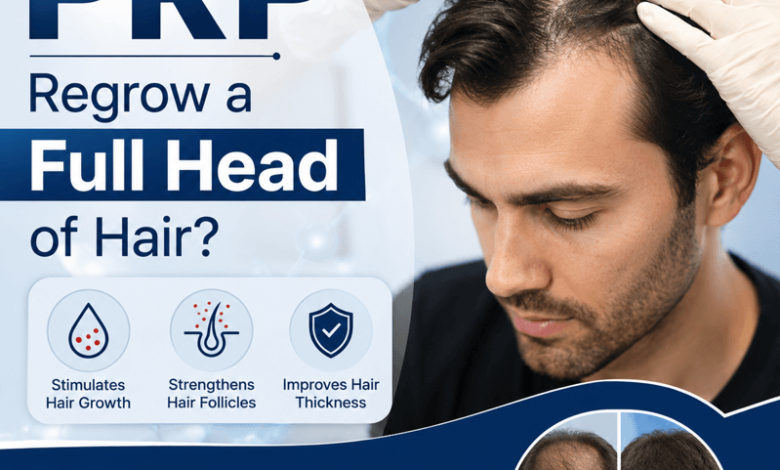
The loss of hair can be seen as a problem in confidence and self-image at any age. PRP therapy has become one of the most popular searches in thinning hair with the increased interest in non-surgical solutions. The major question many people ask is a simple question that is rather important: can PRP regrow a full head of hair, or does it only slow hair fall? Natural expectations get the correct expectations before initiating treatment.
Basics Process of PRP Therapy For Hair Growth
PRP stands for platelet-rich plasma. It is done using a small sample of the patient’s blood. The concentrated platelets are then injected into the scalp after processing. These platelets have growth factors that aid in the repair of cells and follicle activity.
PRP is effective in the restoration of the hair because it encourages inactive follicles and enhances the blood flow to the head. It fails to develop new follicles. Rather, it increases the performance of already existing ones. That distinction plays a key role in understanding results.
How PRP Impacts Hair Density Over Time?
PRP therapy primarily enhances hair density and reduces shedding. Early to moderate hair thinning patients usually report that they have stronger strands and better coverage following multiple sessions. The scalp environment is made healthier, and the weak follicles can generate thicker hair. It is, however, not realistic to expect PRP to restore bald areas completely. Regions of total inactive follicles do not respond. PRP is effective in cases when the follicles are already weak.
Will PRP Alone Create Full Hair Coverage?
PRP, which is a recent method of hair growth, cannot restore a complete head of hair in severe cases of baldness. It performs best when the loss of hair is recent or persistent. In people with diffuse thinning, PRP can be of great benefit to their density and scalp coverage to create the impression of a fuller head of hair.
PRP is commonly applied together with other treatments in cases of severe hair loss. PRP is combined with medications or surgery by many specialists to achieve better results. PRP used a supportive role, not as an independent solution in advanced cases.
Who Benefits the Most from PRP Hair Treatment?
PRP should be used in individuals with early hair loss, pattern baldness, or stress shedding. Active follicles are better in men and women. It is also applicable post surgeries on hair transplant to aid healing and increase the survival of the grafts. Young patients who have genetic hair loss can treat it quite early when PRP is applied. The failure to treat early enough and leaving bald spots is usually limiting in its outcomes. Follow-up assessment helps in the establishment of whether PRP is the appropriate choice.
The Value of Special Evaluation in PRP Results
The success of PRP depends heavily on technique, preparation quality, and treatment planning. Before prescribing sessions, a specialist examines the stage of the scalp, loss of hair, and any medical issues. Misplaced depth or improper concentration of platelets may decrease performance.
Dr Naveed Azhar is well known for his experience in hair restoration and regenerative treatments. His treatment involves individualized evaluation as opposed to standardized treatment plans. The patients are advised according to the expectations, and their expectations do not go against medical science.
Royal Cosmetic Surgery Clinic Islamabad’s PRP treatment is aimed at ensuring the health of the follicle with evidence-based approaches. Long-term maintenance plans and proper spacing between sessions are significant to the result.
See also: Why Fitness Training Is Crucial for Maintaining Your Health and Wellbeing
How Many Sessions Are Needed for Visible Results?
The majority of patients need several sessions, separated by several weeks. The first outcomes can be seen in 3 to 4 months. The hair grows thicker, the shedding decreases, and the coverage of the scalp gradually picks up. PRP is not a one-time solution. Sessions of maintenance are usually required to maintain results. Hair loss is a progressive disease, and continued attention allows delaying the additional impoverishment.
PRP Vs Hair Transplant Expectancies
Hair transplant and PRP are used for different purposes for skin, joints, and hair’s better health. PRP enhances the quality of existing hair, whereas transplant surgery transports follicles to empty parts. It is disappointing to expect PRP to be able to substitute for surgery. PRP is, in most instances, used before or after transplant to improve results. It enhances the healing process of the scalp and supplements the hair of the surrounding area, making it look more natural.
Final Thoughts!
PRP cannot completely regrow a full head of hair in advanced baldness, but it can noticeably enhance the quality and density of hair in the appropriate candidates. It is an effective tool when applied correctly and at the appropriate hair loss phase.
PRP, under the supervision of the skilled professionals such as Dr Naveed Azhar, will be included in an extensive hair restoration plan rather than a quick solution. Through achievable goals and appropriate advice, PRP is still worth considering by individuals who want to experience no-surgery hair enhancement with platelet rich plasma therapy, hair growth treatment, non-surgical hair growth, and scalp rejuvenation treatments.