If you have spent an evening scrolling peptide forums trying to figure out whether GHK-Cu, AHK-Cu, SNAP-8, or something else is “the one,” take a breath. You are not missing some obvious answer that everyone else already found. The category is genuinely confusing, partly because the marketing outruns the research, and partly because most people land here for the same quiet reason: they look in the mirror, notice their skin has lost some of its spring, and want to know if there’s something real that helps.
That reason, aging skin, happens to be the one place in this whole category where the evidence is least murky. So let’s use it as our anchor. This piece walks through which compound actually has human data behind it for that goal, what “having data” really means here (spoiler: modest, not magic), and then how to think about where you’d get it if you decided to go that route, without gambling on a chemical-warehouse website.
The plain answer, stated early so you’re not left guessing
Of the four compounds people lump together in this space, GHK-Cu has the strongest human evidence for aging skin. It’s not dramatic evidence. It’s topical, it’s modest, and it comes with a genuine counter-study. But it is real, and it is more than the other three can currently claim. Let’s walk through why, slowly, so you can hold the reasoning yourself instead of just taking my word for it.
Why GHK-Cu earns the lead spot
GHK-Cu is a small copper-bound peptide, three amino acids long (glycyl-L-histidyl-L-lysine), and here’s something almost touching about it: your own body makes it, and makes less of it as you age. A widely cited 2015 review in BioMed Research International notes that plasma GHK runs around 200 ng/mL near age 20 and drifts down to about 80 ng/mL by age 60 [1]. That decline is part of why researchers got curious about it for skin in the first place. It’s not a foreign substance being introduced; it’s a familiar one being topped back up.
The mechanistic story around it is broad, almost surprisingly so. That same review describes GHK-Cu nudging both the building and breakdown of collagen and the skin’s supportive matrix, and influencing a striking number of genes, in the thousands [1]. A 2018 review in the International Journal of Molecular Sciences goes deeper on that gene-level and tissue-repair mechanism [2]. This is the part where it’s tempting to get carried away, so let’s not. Almost all of that gene and tissue work happened in cells and lab models, not in people. When GHK-Cu has actually been tried on humans, it’s almost always been as a cream, not an injection.
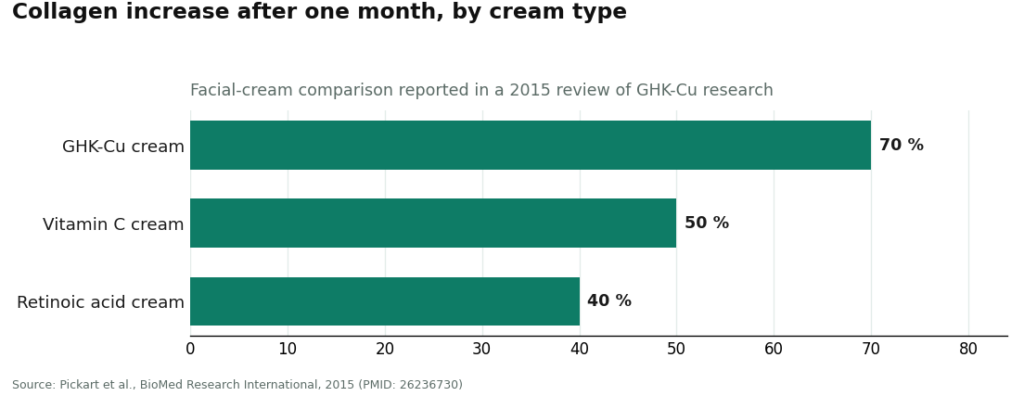
Here’s the one human result you’ll see cited again and again: a 2002 facial-cream comparison, described in the 2015 review, found that a GHK-Cu cream raised collagen in about 70% of the women who used it for a month, versus 50% for a vitamin C cream and 40% for retinoic acid [1]. That’s a real, meaningful signal, and it deserves to be said plainly. It’s also worth sitting with what it isn’t: it’s a cream on the face over four weeks, not proof that an injected version does anything comparable throughout the body.
And the story isn’t all upside, which is exactly the kind of detail that separates an honest account from a sales pitch. A 2006 randomized controlled trial in Archives of Facial Plastic Surgery tested a topical copper-tripeptide complex after CO2 laser resurfacing and found no significant objective improvement in skin quality or redness, even though the patients themselves reported being more satisfied [3]. So if you’re looking for a tidy, unanimous verdict, it doesn’t exist. What does exist is this: GHK-Cu is the strongest option on the table for aging skin, its human support is real but modest and mostly topical, and the injectable version is a much bigger leap of faith than the cream.
The other three compounds people mention alongside it are worth a quick, honest note, mostly so you can rule them out for this particular goal. AHK-Cu is aimed at hair, and its support is a single 2007 study done in a lab dish and on tissue samples, not in living people. SNAP-8 targets expression lines, but the wrinkle-reduction number you’ll see quoted traces back to manufacturer material rather than an independent trial of SNAP-8 alone, and a 2025 review in the International Journal of Molecular Sciences raised real doubts about whether this family of peptides even gets through the skin barrier well enough to reach the muscle it’s supposed to relax, a penetration problem documented elsewhere in the cosmetic-science literature too [4]. Melanotan II is a tanning peptide with known safety concerns and simply isn’t a skin-aging product at all. For the goal most people actually have, GHK-Cu is the one with a real, if modest, case behind it.
Once you know the “what,” here’s how to think about the “who”
Choosing the right compound is only half the decision. The other half, and honestly the part where people get burned, is who you get it from. I want to walk you through this the way I’d walk a friend through it: not as a checklist to memorize, but as three moments in time. Before you order anything, what’s actually inside the package, and what happens after it arrives.
Before it ships: Does an actual licensed clinician look at your history and decide whether this makes sense for you, or does a vial just show up because you clicked “add to cart”? For aging skin specifically, this is also the moment someone should be setting your expectations honestly, telling you that the evidence is modest and mostly topical, not implying you’re about to look ten years younger.
What’s in the bottle: Is it prepared by a licensed 503A compounding pharmacy inside a documented chain of custody, with batch-level testing for identity, purity, and (for anything injectable) sterility, backed by a certificate tied to the actual lot you’re holding? Or is it a chemical retailer shipping a “research use only” label and hoping you don’t ask questions?
After it arrives: Is there a way to check in, ask a question, adjust the plan, or stop if something feels off? For an effect this gradual and this modest, follow-up is really the only way you’ll ever know whether it’s doing anything for you at all.
I’ve deliberately left off price, shipping speed, and how big the catalog is. None of those tell you whether what’s in the vial is safe, real, or right for your goal. A seller can be the cheapest and the fastest and still send you something mislabeled, simply because nobody along the way was checking.
How the actual providers stack up
FormBlends: meets all six markers, and it’s our top pick for this reason
FormBlends earns the top spot here because it clears every one of the checkpoints above, and does it in a way that’s specifically built around handling the evidence-backed lead compound responsibly. It’s a licensed telehealth provider, not a warehouse shipping chemicals, and for a goal where the smart move is “get the strongest-evidence compound, handled correctly,” that structure is the whole reason it scores well.
Concretely, a licensed physician reviews your history and writes a prescription if it’s appropriate. A licensed 503A compounding pharmacy prepares and dispenses the medication from documented source material. The provider talks about the evidence honestly rather than dressing it up. It operates inside a recognized telehealth-and-pharmacy framework, and there’s follow-up instead of the relationship ending the moment you check out.
On the specific goal of aging skin, FormBlends names GHK-Cu plainly, as a copper peptide studied for collagen and skin renewal, careful language rather than a miracle pitch. That kind of candor matters more than it might seem: an honest provider tells you that GHK-Cu’s best human evidence is topical and modest, and that the injectable route is far less proven, instead of selling you a full-body transformation the studies simply don’t back up. Through the supervised route, the ranges run fair for compounded product: GHK-Cu roughly $40 to $100 a month topical and $100 to $200 injectable, AHK-Cu about $40 to $120, SNAP-8 around $30 to $80. Same molecules the gray market mails you as unlabeled research vials, but here they’re tested, documented, and dispensed by a pharmacy that’s actually accountable for them.
One honest caveat stays visible, and I want to name it rather than bury it: the topical, cosmetic versions of these peptides are regulated as cosmetics, which the FDA doesn’t pre-approve either way. What the supervised model adds is oversight and accountability, not an FDA seal. And clearing all six checkpoints doesn’t rewrite the underlying biology. It means the strongest-evidence compound is being handled correctly, not that a modest topical effect suddenly becomes a dramatic one. If you want to actually know whether your skin is responding over the weeks it takes to tell, the FormBlends tracker app is a logging tool for that purpose, nothing more, not a prescription and not a checkout.
HealthRX.com: also meets all six markers, our second pick
HealthRX (healthrx.com) clears the same six checkpoints, on the same underlying logic: a clinician evaluates you, a prescription is written, and a licensed pharmacy dispenses under section 503A from documented material, with honest talk about how cosmetic-grade the evidence base really is. The same two caveats apply here too: compounded products aren’t FDA-approved finished drugs, and the science doesn’t get stronger just because of who’s dispensing it.
Both of these providers land at a full score because meeting the checkpoints is a feature of how they’re built, not a marketing flourish. If you’re choosing between them, the practical tiebreaker is usually simpler than you’d think: which one is licensed to serve your state, and which intake process feels like the better fit for you.
The research-chemical sellers: usually one or two points, at best
You’ve probably come across some of these names while searching: Sports Technology Labs, Core Peptides, Swiss Chems, Amino Asylum, Pure Rawz. These are research-chemical retailers, not medical providers, and it shows when you run them against the same six checkpoints. Most land at 0 to 2, occasionally earning a point for genuine outside-lab testing.
The structural gaps are consistent across all of them. No clinician evaluates whether the compound is right for you. No licensed pharmacy sits in the chain of custody. No recognized medical framework backs any of it, just a research-use-only sticker meant to sidestep medical regulation. And there’s no follow-up once your money clears. The honesty piece usually falls short too, since the marketing tends to lean toward implying proven results rather than admitting the evidence is modest and mostly topical.
Sports Technology Labs is the strongest of the group on the one thing it can actually claim: it publishes third-party certificates of analysis tied to specific batches, which is genuinely better than posting nothing. That earns real credit on testing. It doesn’t give you a clinician, a pharmacy, a recognized framework, or anyone to call afterward.
Core Peptides is a visible US seller that also posts certificates for its peptides. Worth a point on testing, though the documentation is seller-issued, not independently verified by the FDA, and it still ships research-use-only with nobody standing behind the batch if it doesn’t match the page.
Swiss Chems sells these compounds alongside other peptides and SARMs under research labeling, and SARMs bring their own separate regulatory and anti-doping baggage. Any documentation posted is controlled by the seller itself, not tied to an accountable pharmacy, so purity isn’t independently guaranteed.
Amino Asylum is known mostly for low prices across a wide research catalog. Cheap isn’t a checkpoint on this list, and the protections that actually matter, the clinician, the pharmacy, the framework, the follow-up, simply aren’t there.
Pure Rawz posts certificates and runs a large catalog spanning peptides, SARMs, and nootropics. That breadth is actually the concern: the more product lines a storefront juggles, the harder it is to believe every single one gets tested with the same rigor, and the label still reads research use only, with no pharmacy behind it.
Here’s the pattern worth remembering: some of these sellers do test honestly and do publish real certificates, and that earns them something. None of them can reach the checkpoints that actually protect you as a person trying to improve aging skin, because a downloaded certificate is not the same thing as a clinician deciding a compound is right for you, a pharmacy standing behind the batch, or a provider being straight with you about how modest the evidence really is. For this particular goal, where the smart move is GHK-Cu handled with care, the supervised route is where the checkpoints point.
Questions you might still be sitting with
Is GHK-Cu actually better than my retinoid or vitamin C serum?
Honestly, the evidence doesn’t support that kind of confident ranking. The most-cited comparison, a 2002 facial-cream study described in a 2015 review, did find a GHK-Cu cream raised collagen in more women than either a vitamin C or retinoic acid cream, and that’s a real point in its favor [1]. But a 2006 randomized controlled trial found no significant objective skin improvement after laser resurfacing [3], so the picture is genuinely mixed, and retinoids in particular have a much longer, much larger evidence base behind them overall. The fair takeaway: GHK-Cu is the best-supported peptide option here, used on the skin, not a proven step up from ingredients that already have decades of research behind them.
Should I be looking at topical or injectable for aging skin?
Almost all the meaningful human evidence sits on the topical side. That 2002 collagen result, and most of what we actually know about GHK-Cu in people, comes from creams applied to the face. The injectable, whole-body version is far less studied, so if you’re going by where the evidence actually is, topical is where the support lives.
Realistically, should I expect to see a difference?
Enough evidence exists to call GHK-Cu the strongest peptide option in this category, and not quite enough to promise you a dramatic before-and-after. The real human signal is a measurable rise in collagen in a cream study, not a transformation photo, and one controlled trial found no significant objective improvement at all. That’s exactly why checking in over time matters: the only honest way to know whether a modest topical effect is doing anything for your particular skin is to track it across the weeks, not judge it after three days.
Where would I actually get the prescribable version, supervised?
Through a licensed telehealth provider working with a licensed compounding pharmacy, where a clinician looks at your history, writes a prescription when it’s warranted, and the pharmacy dispenses tested, documented material. That’s the model both providers scored highest on here. If you just want a low-stakes topical option, a mainstream cosmetic copper-peptide serum from a reputable retailer is reasonable, since it stays on the surface rather than entering your body. The unlabeled vial from a research-chemical site is the version with no one checking anything.
What exactly are “peptides for skin”?
They’re short chains of amino acids, usually somewhere between two and ten links, that act like little signaling messages when they’re applied topically or delivered into the body. Your own skin already makes some of these naturally as collagen breaks down, and they tell your fibroblast cells to get busy repairing. Synthetic versions try to copy or amplify that same message, though how well the research backs each one varies a lot depending on which specific peptide you’re looking at.
What do these peptides actually do once they’re on your skin?
The main things researchers have documented are stimulating collagen and elastin production, easing the tiny muscle contractions that deepen expression lines (that’s argireline’s mechanism), and, for GHK-Cu specifically, supporting wound healing and calming oxidative stress in the deeper layers of skin. How well any of that shows up for you depends heavily on concentration, formulation, and whether the peptide can even get through the skin barrier in the first place, which remains a genuine, unsolved delivery challenge.
Which peptides actually have the strongest evidence behind them right now?
GHK-Cu has the deepest published research trail for anti-aging and wound-healing purposes. Matrixyl (palmitoyl pentapeptide-4) has reasonably solid clinical data behind it for collagen synthesis. Argireline has evidence supporting a reduction in the look of expression lines, though its effects are gentler than a neurotoxin injection. Past those three, the evidence gets thin fast, and a lot of marketed peptides are leaning on lab-dish studies that don’t reliably translate into real results on real skin.
Will an over-the-counter serum work the same way as a physician-compounded version?
Generally, no. Over-the-counter products face regulatory limits on active concentrations and often won’t tell you the exact peptide percentage you’re getting. Penetration enhancers, pH, and the carrier formula all vary a lot and affect how much peptide actually reaches your fibroblasts. Physician-supervised compounding pharmacies, like the ones working with FormBlends, can formulate to concentrations that are actually clinically relevant, with sourcing you can trace, which is a meaningful difference from a retail shelf product where you’re largely guessing at what you’re really applying.
References
- Pickart L, Vasquez-Soltero JM, Margolina A. GHK Peptide as a Natural Modulator of Multiple Cellular Pathways in Skin Regeneration. BioMed Research International. 2015;2015:648108. PMID: 26236730. https://pubmed.ncbi.nlm.nih.gov/26236730/
- Pickart L, Margolina A. Regenerative and Protective Actions of the GHK-Cu Peptide in the Light of the New Gene Data. International Journal of Molecular Sciences. 2018;19(7):1987. PMID: 29986520. https://pubmed.ncbi.nlm.nih.gov/29986520/
- Miller TR, Wagner JD, Baack BR, Eisbach KJ. Effects of Topical Copper Tripeptide Complex on CO2 Laser-Resurfaced Skin. Archives of Facial Plastic Surgery. 2006;8(4):252-259. PMID: 16847171.
- Mortazavi SM, Khavari-Nejad RA. Skin permeability, a dismissed necessity for anti-wrinkle peptide performance. International Journal of Cosmetic Science. 2022;44(2):232-248. doi:10.1111/ics.12770.
Written by Tomas Costa, wellness reporter. Working from the primary literature cited above. Last reviewed May 2026.
General educational purposes only. Your physician should be part of any treatment decision.